

Characterization of the genome of the wild dioecious yam (Dioscorea tokoro) has shed light on the chromosomal architecture governing sex determination in this model species for evolutionary biology.
Key takeaways from this study :
-
An XY sex determination system : Genomic analysis confirmed that D. tokoro operates under a male heterogametic system, where male individuals are XY and females are XX.
-
Localization of the SDR : The sex-determining region (SDR) was mapped and localized to chromosome 3.
-
Identification of candidate genes : Fine-scale analysis of this region revealed Y-specific genes involved in floral development.
Why this discovery is essential : As a wild species closely related to cultivated yams, D. tokoro serves as a valuable model for comparing sex chromosome evolution across the genus. Characterizing its SDR provides a major benchmark for studying sex-system turnover among yam species and identifying ancestral regulatory genes.
Kudoh, A., Akagi, T., Tamiru-Oli, M., Suzuki, S., Murano, S., Natsume, S., Takagi, H., Yamanaka, S., Terauchi, R., & Matsumoto, R. (2026). Whole-genome sequencing reveals a possible molecular basis of sex determination in the dioecious wild yam Dioscorea tokoro. PLOS Genetics. https://doi.org/10.1371/journal.pgen.1012123
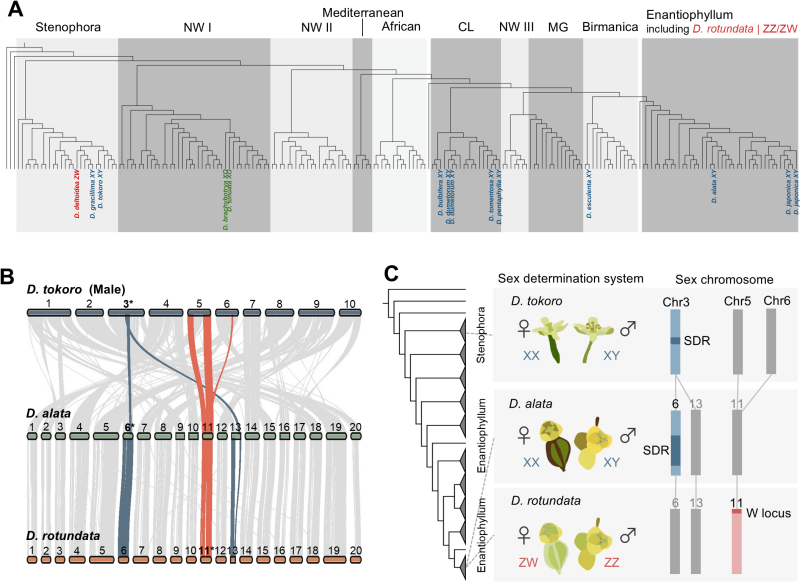
This figure illustrates the evolutionary transitions of sex-determination systems and sex chromosomes within the genus Dioscorea. The phylogenetic tree in Figure 4A displays the distribution of sex systems across 183 species, revealing the coexistence of XY/XX and ZZ/ZW systems within several evolutionary sections, including Stenophora and Enantiophyllum. Synteny analysis based on gene order in Figure 4B compares the chromosomes of D. tokoro, D. alata, and D. rotundata, highlighting overlapping genomic blocks (blue and red ribbons) harboring the SDR regions across these species. Finally, the comparative diagram in Figure 4C summarizes sex chromosome evolution, illustrating the shift from male heterogametic XY systems (SDR located on chromosome 3 in D. tokoro and on chromosome 6 in D. alata) to a female heterogametic ZW system in D. rotundata (W locus carried on chromosome 11).