

The assembly of the first reference genome for white Guinea yam (Dioscorea rotundata, 405 Mb) has unveiled the genetic mechanisms governing sex determination in this major staple crop.
Key takeaways from this study:
-
A ZW sex determination system: QTL-seq genomic analysis demonstrated that sex in D. rotundata is controlled by a heterogametic system where female individuals are ZW and male individuals are ZZ.
-
Localization of the SDR: The sex-determining region (SDR) was mapped with high precision onto chromosome 11.
-
Development of the sp11 marker: Characterization of this region led directly to the creation of a diagnostic molecular marker specific to female plants.
Why this discovery is essential: By enabling early sex identification at the seedling stage through a simple laboratory DNA test, the sp11 marker eliminates the need to wait for flowering in the field. This breakthrough simplifies nursery management, secures breeder selection, and significantly accelerates breeding and crop improvement programs.
Tamiru, M., Natsume, S., Takagi, H., Uemura, A., Terauchi, R., & Matsumoto, R. (2017). Genome sequencing of the staple food crop white Guinea yam enables the development of a molecular marker for sex determination. BMC Biology, 15(1), 86. https://doi.org/10.1186/s12915-017-0419-x
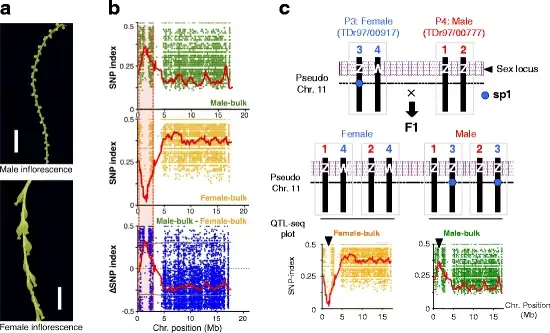
This figure provides visual evidence for the location of the sex locus in Dioscorea rotundata. Following the photographic presentation of male and female inflorescences in Figure 4a, the QTL-seq plot in Figure 4b compares the genomic pools: the Δ(SNP-index) signal reveals a single, highly significant peak at the beginning of chromosome 11, isolating the SDR region within the genome. Finally, the diagram in Figure 4c details the inheritance of the locus under a ZW system and shows the positioning of the diagnostic marker sp11, which is associated with the female-specific region.