

The identification of the first documented case of monoecy and sex lability in the greater yam (Dioscorea alata) hybrid CIRAD187 challenges the long-held assumption of strict dioecy in this critical food security crop.
Key takeaways from this study :
-
Decoupling of genotype and sexual phenotype : Genotyping with the sad6 marker confirms that the monoecious hybrid CIRAD187 carries a male genotype (XY), demonstrating that the presence of the Y chromosome alone is not sufficient to enforce an exclusively male phenotype.
-
Transcriptomic and hormonal reprogramming : Characterization of male, female, and intermediate flowers reveals distinct gene expression modules as well as a strict jasmonic acid gradient (male > intermediate > female) directly correlated with floral sex differentiation.
-
Fertility and compatibility : Controlled pollination and selfing experiments confirmed the functional fertility of both male and female flowers produced on the same inflorescence, giving rise to viable seeds and seedlings.
Why this discovery is essential : By demonstrating the plasticity of sex expression and highlighting the central role of jasmonic acid alongside underlying regulatory pathways, this study provides an unprecedented molecular framework to overcome the constraints of dioecy. Harnessing this sex lability paves the way for facilitating controlled crosses and enabling self-pollination, thereby accelerating the breeding of more productive and resilient yam cultivars.
Dossa, K., Malédon, E., Gravillon, M.-C., Perrot, C., Nazir, M. F., Nudol, E., Laurent, L., & Chaïr, H. (2026). Monoecy in an XY yam reveals labile sex expression and hormonal reprogramming in Dioscorea alata. Annals of Botany, mcag303. https://doi.org/10.1093/aob/mcag303
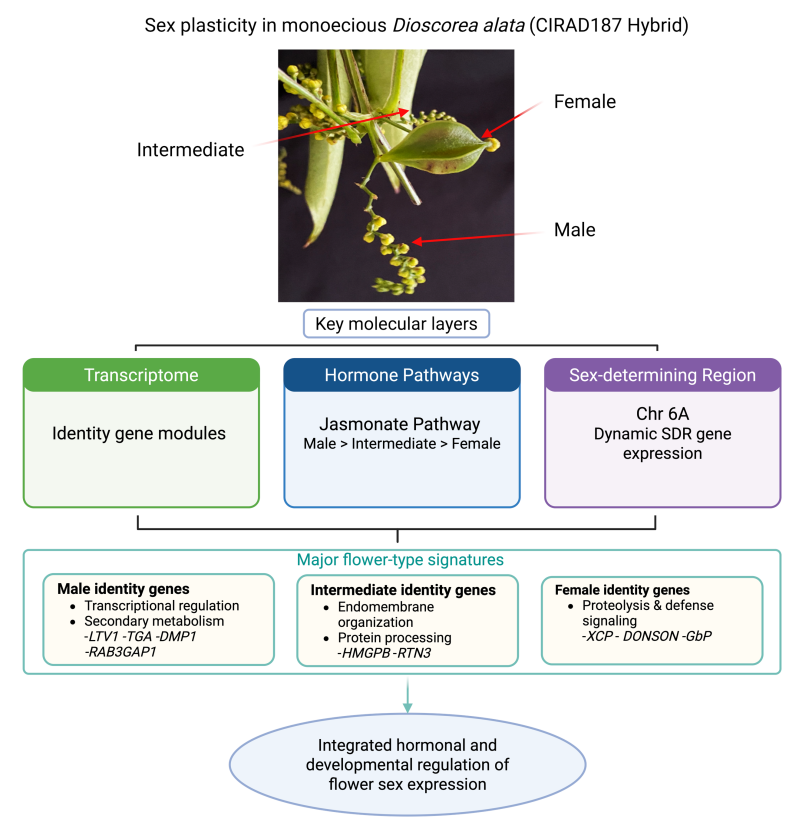
This figure summarizes the model of sex expression plasticity in the monoecious hybrid CIRAD187 (Dioscorea alata) by coordinating three molecular regulatory layers that govern floral phenotype despite its XY male genotype. At the top, the diagram illustrates the simultaneous presence of male, female, and intermediate flowers on the same inflorescence. In the center, the scheme details the transcriptomic landscape with its flower-type identity modules (proteolysis and defense signaling for female flowers, transcriptional regulation for male flowers, and protein processing in the endoplasmic reticulum for intermediate flowers), the decreasing hormonal gradient of jasmonic acid (male > intermediate > female), and the dynamic expression of 40 key genes located within the sex-determining region (SDR) on chromosome 6A. Together, these layers converge to demonstrate that final sex expression in greater yam results from integrated hormonal and developmental reprogramming rather than strict chromosomal control.